IF IT GOES ... IT'S VEHICULAR
X-Chock Wheel Stabilizer: 5 Minutes to a Stable Trailer
Every travel trailer rocks. That is just the physics of the thing. You put a box on wheels, run a set of stabilizer jacks down to the ground, and you have done approximately nothing about the fore-to-aft motion that makes the whole rig feel like a boat at anchor. Scissor jacks control side-to-side sway reasonably well, but the moment someone walks from the bedroom to the kitchen, you feel it. The BAL X-Chock wheel stabilizer is designed to address exactly that problem, and after installing a set for the first time on my Jayco Jay Flight SLX 265BHS, I can tell you they work.
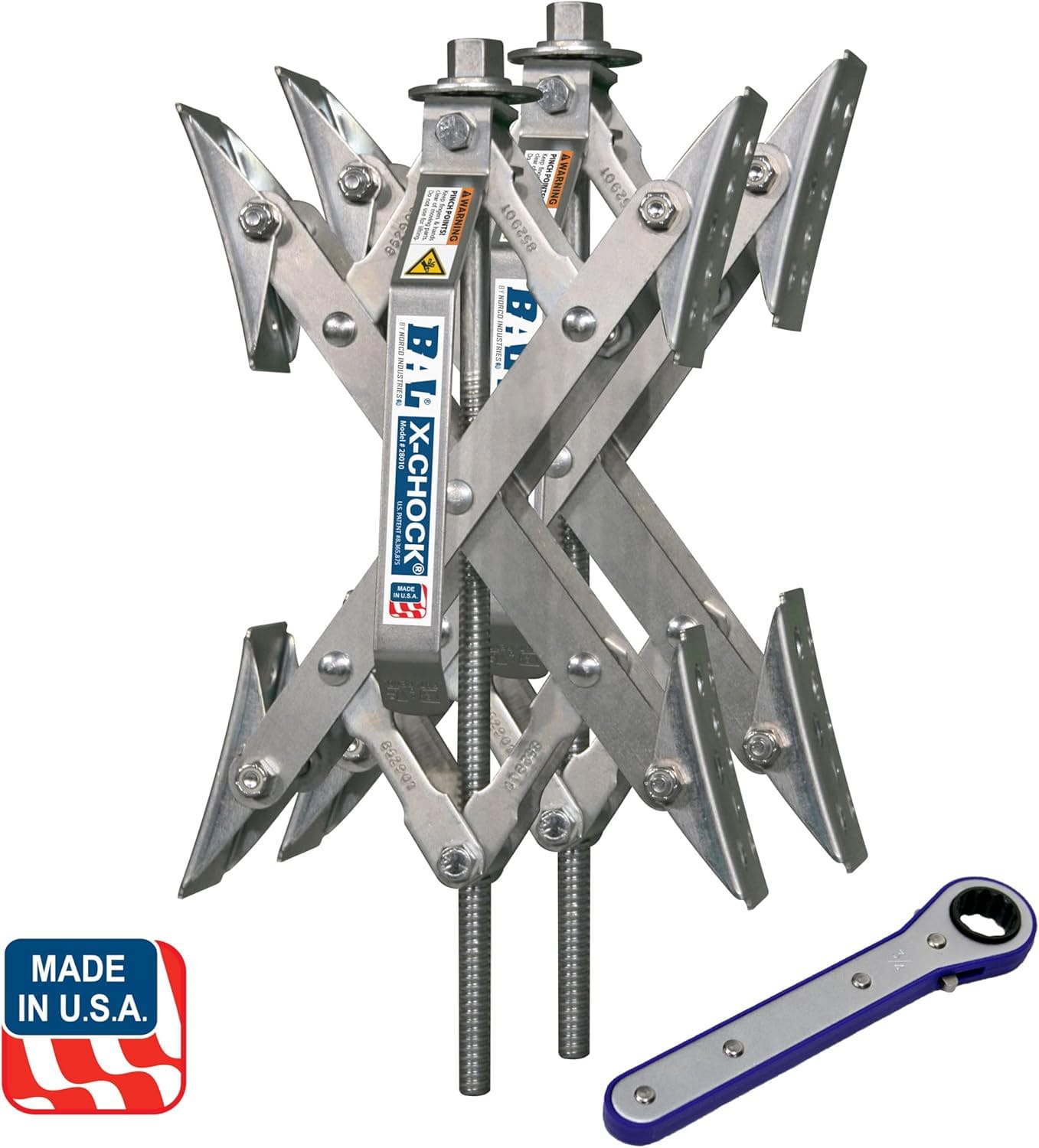
The X-Chock wheel stabilizer ships as a two-pack with a ratcheting wrench included.
What the X-Chock Wheel Stabilizer Actually Does
The concept is straightforward. Each X-Chock is a threaded wedge device that you install between the tires on a tandem axle trailer. You place one chock between the front tire and the rear tire on each side, then tighten the mechanism until the chock is snug against both tire sidewalls. The result is that the tires cannot roll forward or backward relative to each other, which eliminates the rocking motion that stabilizer jacks alone cannot control.
This only works on trailers with at least two axles. You need a tire on both sides of the chock for it to have anything to push against. Single-axle trailers are out. If you have a tandem or triple axle setup, the X-Chock is a direct fit for the problem.
The physics here are not complicated. Your stabilizer jacks keep the trailer from bouncing on its suspension, but they do not lock the wheels. The X-Chocks lock the wheels. Those are two different problems, and most people only solve one of them.
What Comes in the Box
The kit I bought came with two chocks and a ratcheting wrench for tightening. That covers both sides of a tandem axle trailer, which is exactly what you need. The wrench fits the tightening mechanism at the top of the chock body.
One thing worth knowing before you set up for the first time: the wrench works, but it is slow going if you are starting from scratch with the chock fully retracted. I ended up grabbing my drill to spin the mechanism down until the chock was close to contact, then placed it by hand between the tires with one hand free, thumb-tightened it until it touched both sidewalls, and finished with the included wrench to cinch it down fully.
I would have preferred to run the drill the whole way, but the tightening mechanism sits at the top of the chock, and that placement is actually smart design. It limits how much torque you can apply before the mechanism makes it obvious you are pushing too hard. You are probably not going to overtighten these with the included wrench. A drill is a different story, which is likely why the design discourages it for the final snug-down.
How to Install an X-Chock Wheel Stabilizer Correctly
Installation is not difficult, but there is a right way to do it and a wrong way that will cost you the benefit.
Level and block the trailer first, the same way you always would. Get the rig where you want it, run your leveling system, and drop your stabilizer jacks. Do all of that before the X-Chocks go in. Once the trailer is set, that is when these go between the tires.
Extend the chock until it is close to the gap between your tires. The gap will vary depending on your wheel and tire combination, so there is no single measurement that applies to every setup. Get it close before you try to place it, or you will be fighting the mechanism one-handed in an awkward position.
Place the chock between the tires and thumb-tighten until you feel contact on both sidewalls. The goal at this stage is contact, not compression. You want the chock seated and stable so it will not fall out when you pick up the wrench.
From there, use the ratcheting wrench to tighten. Snug is the right word for the final tension. You want the chock firm enough that it will not shift, but you are not trying to deflect the rubber of the tire. If the sidewall is visibly deforming, you have gone too far. Back it off. The chock does its job by preventing wheel movement, not by crushing the tire.
The Difference You Feel
I installed the X-Chocks on the Jayco for the first time and walked the trailer before and after to get a baseline comparison. The fore-to-aft rocking that scissor jacks and a four-point leveling system leave behind was noticeably reduced. Not eliminated entirely, because no ground-contact stabilizer eliminates all motion from a travel trailer, but the improvement was immediate and real.
The direction the X-Chock wheel stabilizer addresses is the one that most stabilization setups handle poorly. Side-to-side is easier to manage with jacks because you are resisting lateral load across a wide footprint. Front-to-back is harder because the wheels are free to roll, and rolling is what they are designed to do. X-Chocks remove that freedom while you are parked, and you feel the difference the first time someone walks through the rig.
If you have ever been in a trailer where every footstep sends a wave through the floor, you know what problem these are solving.
What X-Chocks Do Not Do
They do not replace your stabilizer jacks. They do not level the trailer. They do not do anything about vertical bounce from soft suspension or undersized jacks. They address one specific problem, which is wheel movement causing fore-to-aft rocking, and they address it well. Go in with accurate expectations and you will not be disappointed.
They also require a tandem or multi-axle trailer. If your setup only has one axle, this is not the product for you.
Build Quality and Value
The construction feels solid. There is nothing flimsy about the mechanism, and the ratcheting wrench is a better inclusion than the cheap fixed wrenches that some competing products ship with. The price point for a set of X-Chocks is reasonable for what you get, especially given that a single camping trip with a stable trailer is worth more than the cost of the chocks.
The two-chock kit covers one tandem axle trailer completely. If you have a triple axle or want redundancy, buy two kits. The per-unit cost stays reasonable either way.
X-Chock Wheel Stabilizer vs. Scissor Jacks Alone
Most trailers ship with some version of scissor-style stabilizer jacks as standard equipment. Those jacks are not worthless. They reduce the bounce and sway that comes from the trailer sitting on its suspension springs, and they are part of a complete stabilization setup. But they leave the wheels free to roll, and that is the gap the X-Chock fills.
Think of it as two separate systems solving two separate problems. Jacks handle vertical movement and lateral sway. X-Chocks handle the longitudinal rocking that jacks cannot reach. Running both together gives you a meaningfully more stable trailer than either one alone.
Some people add rubber pads under their stabilizer jacks for better grip, use tongue weight bags, and otherwise pile on the stabilization methods. X-Chocks fit cleanly into that stack and do not interfere with anything else you are already doing.
There are cheaper imitation chocks on the market that use a similar wedge concept but skip the ratcheting mechanism in favor of a simple bolt. Those work to a degree, but the ratcheting wrench on the X-Chocks makes repeatable, consistent tension significantly easier to achieve, especially if you are setting up alone. The ability to hold the chock in place with one hand and drive the ratchet with the other is worth the small price difference over the no-name alternatives.
Setup and Teardown Time
Installation takes a few minutes per side the first time while you are figuring out the right extension length for your tire gap. Once you have done it once and have a feel for the starting position, setup drops to under two minutes per chock. Teardown is faster. Loosen the wrench, retract the chock, pull it out. Done.
They store flat in a small space. I keep mine in the Jayco’s exterior storage bay with the rest of the leveling and stabilization gear. They weigh almost nothing and take up very little room. If you are putting together a complete stabilization setup, every X-Chock wheel stabilizer in that bay earns its keep on the first night.
Bottom Line
The BAL X-Chock wheel stabilizer does exactly what it claims to do. It eliminates the fore-to-aft rocking that scissor jacks ignore, installs in minutes, and is built well enough to last for years of regular use. The included ratcheting wrench is a nice touch. The top-mounted mechanism keeps you from overtightening and damaging your tires, even if it means you cannot run a drill to the finish line.
If you have a tandem axle travel trailer and you are still tolerating the rocking, there is no good reason not to have these. They are inexpensive, they work, and the first time you walk through a stable trailer you will wonder why you waited.