IF IT GOES ... IT'S VEHICULAR
RV Tankless Water Heater: 1 Simple Setting Change That Fixes Everything
Most of the complaints I see online about RV tankless water heaters come down to one thing: people are using them the same way they use a water heater at home. That instinct is understandable and it is also wrong. Once you understand what the unit is actually doing, the complaints mostly disappear.
How an RV Tankless Water Heater Actually Works
A traditional tank water heater stores a fixed volume of hot water and keeps it ready. When you open the hot tap, you draw from that stored supply. The tank refills and reheats on its own schedule. You know the drill. You have probably also experienced the moment when the tank runs out and someone three campsites away gets to hear about it.
An RV tankless water heater works on demand. Cold water flows through a heat exchanger, propane fires up, and the water is heated as it moves through. There is no stored supply to deplete. What that also means is that the output temperature is a function of the incoming water temperature and the flow rate. The unit is doing math in real time. When you mess with that math by mixing in cold water at the faucet, you are adding a variable the heater did not account for, and the result is a shower that cannot decide what temperature it wants to be.
The 2026 Jayco Jay Flight SLX 265BHS I tow comes with a standard 60,000 BTU propane tankless water heater. It is a capable unit and I have had zero complaints once I figured out what it actually wanted from me.
The Mistake Almost Everyone Makes
The habit from home is to turn on both the hot and cold valves and blend to taste. In a house with a tank heater, this works fine. The hot water is hot, the cold water is cold, and the mixing valve in your shower head or at the faucet gives you a predictable result.
In an RV with an RV tankless water heater, blending creates a feedback problem. The unit senses flow and fires the burner to reach the set temperature. When you introduce cold water at the fixture, you are pulling less hot water through the system, which changes the heat exchanger dynamics. The burner modulates. The temperature swings. You chase it with the cold handle, which makes it worse. Some people spend the entire shower doing this and then go online to complain that their RV water heater is garbage.
It is not garbage. You are fighting the system instead of working with it.
How to Use an RV Tankless Water Heater Correctly
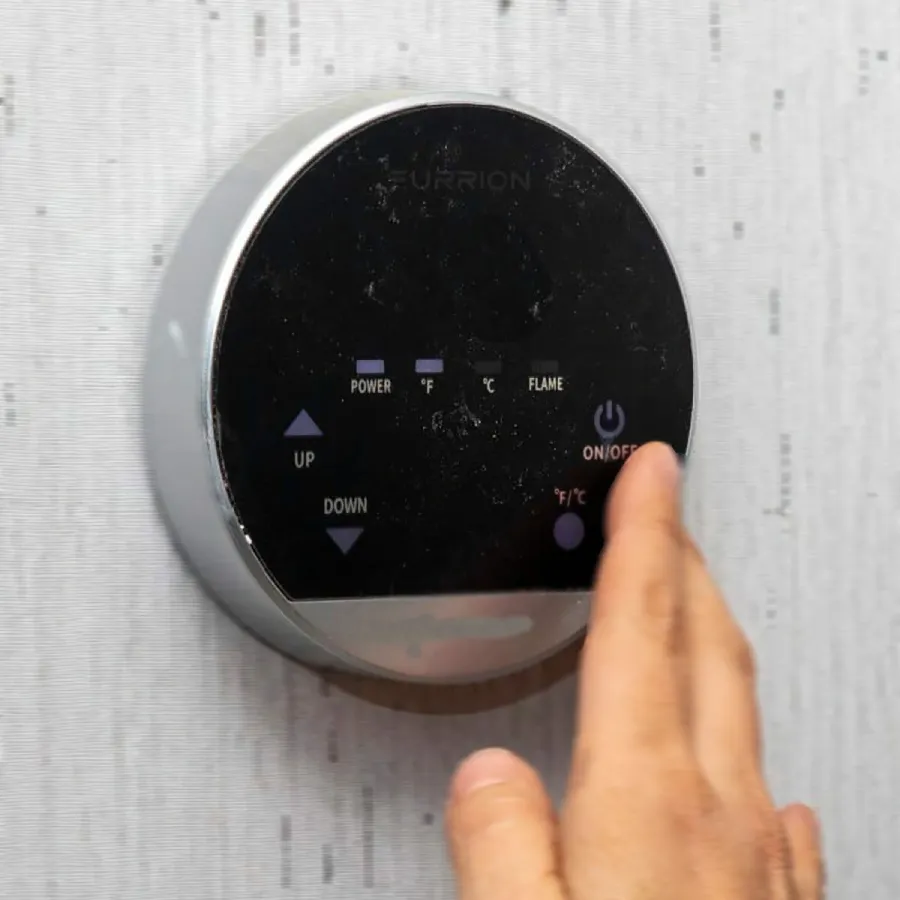
Set the water heater to 100 degrees and use only the hot water valve. Do not mix. Open the hot tap, let it run for a few seconds while the heater fires and the line clears, and then get in.
At 100 degrees you are already in the range that dermatologists consider ideal for showering, which is 98 to 105 degrees. You are not running scalding water. You are running comfortable water, and you are running it without introducing the cold-water variable that makes the unit hunt for a setpoint it cannot hold.
The results are immediate and the math is obvious once you see it. You use less water because you are not running both valves and waiting for a blend to stabilize. You use less propane because the unit is not cycling the burner up and down chasing a moving target. Your shower is more consistent from start to finish.
This is one of those adjustments that takes about ten seconds and makes a noticeable difference on the first try.
RV Water Pressure Is Not House Water Pressure
There is a second problem that compounds the first one, and it is the reason I am going to bring up the Oxygenics BodySpa RV Handheld Shower Head.
RV water systems do not run at house pressure. A residential system typically delivers 60 to 80 PSI at the tap. Most RV systems are regulated down to 40 to 55 PSI to protect the plumbing, and depending on your hookup situation, you may see less than that. A shower head designed for residential pressure at 60-plus PSI will feel weak and unsatisfying at 45 PSI. That is not a problem with your water heater. That is a problem with your shower head.
The Oxygenics BodySpa is engineered specifically for lower-pressure RV systems. It uses an internal pressure-compensation mechanism that maintains spray force even when inlet pressure drops. The difference between this head and the builder-grade unit that came in my Jayco was significant enough that I noticed it immediately. It also uses less water per minute, which matters when you are on a limited fresh tank or trying to conserve propane.
If you fix your temperature technique and upgrade your shower head, your RV shower will be better than a lot of hotel showers. That is not a low bar to clear, but it is worth clearing.
Propane and Water Conservation in Practice
One of the selling points of a tankless water heater is efficiency. You only heat water when you are actively using it, which means you are not burning propane to keep a tank warm overnight or between uses. That efficiency advantage is real, but it evaporates quickly if you are running both valves wide open trying to blend your way to comfort.
At 100 degrees, hot-tap-only, you can take a satisfying ten-minute shower and use a fraction of the propane and water you would burn through doing it the mixed-valve way. When you are dry camping or running on a limited fresh tank, that difference matters. It is also worth noting that the tankless unit will not fire at all if the flow rate drops below the activation threshold, which means a low-flow shower head that drops below that threshold will give you cold water regardless of your settings. The Oxygenics unit maintains enough flow to keep the heater engaged without wasting water, which is why they are popular in the RV market.
What the Temperature Setting Actually Controls
The temperature dial or digital control on your RV tankless water heater sets the target output temperature. The unit will do its best to hit that target based on incoming water temperature and flow rate. In cold weather, when your fresh tank has been sitting in 40-degree air, the incoming water is colder and the unit has to work harder to reach the setpoint. In summer, when the tank has been sitting in the sun, the incoming water may already be 70 degrees or warmer, and the heater barely has to work at all.
This is why seasonal adjustment of the temperature setting makes sense. What works perfectly in July may need a bump in October. If you are camping in cold weather and your shower is not as warm as you expect even with the correct technique, check the incoming water temperature first. The unit may simply be working at the limits of what 60,000 BTUs can accomplish against very cold inlet water and high flow demand.
If you are camping with the Jayco or any other trailer that uses a comparable propane tankless unit, the operating logic is the same regardless of brand. The physics do not change.
A Note on Winterization and Storage
An RV tankless water heater requires the same winterization attention as any other plumbing component in the RV. The heat exchanger contains water passages that will crack if they freeze. If you are storing the trailer in conditions where temperatures will drop below freezing, you need to blow out or drain the water heater just like the rest of the system.
The advantage of a tankless unit in this context is that there is no large tank to drain. The heat exchanger volume is small. A competent blow-out with a compressor will clear it in seconds. What trips people up is forgetting to bypass or drain the unit and then wondering why they have a cracked heat exchanger in the spring.
If you are doing your own RV winterization, treat the RV tankless water heater as a mandatory stop in the process, not an afterthought. It is a relatively expensive component to replace and a simple one to protect.
Getting the Most Out of Campground Hookups
When you are on a full-hookup site with city water, your pressure may be regulated at the campground pedestal, at your pressure regulator, or both. Most RVers run a pressure regulator between the campground water supply and the trailer to protect the plumbing. The Jayco Jay Flight SLX 265BHS, like most travel trailers, has plumbing rated for typical RV pressures, and running unregulated campground water that occasionally spikes above 80 PSI is a way to find that out the hard way.
A regulated hookup with a quality shower head and the correct hot-tap technique will give you a consistently good shower every time. That is the combination that actually works, and it does not require any modification to the trailer itself.
For more on the Jayco Jay Flight SLX 265BHS specifically, including how the trailer performs as a package, see the full review on vehicular.us.
Bottom Line
The RV tankless water heater is a good piece of equipment that most people operate incorrectly because they bring home habits into a system that works differently. Set it to 100 degrees. Use the hot tap only. Do not mix. Pair it with a shower head built for RV pressure, like the Oxygenics BodySpa, and the complaints go away. The efficiency gains are real, the water temperature holds steady, and you stop wasting propane chasing a blend that the system was never designed to provide.
If you are towing a trailer with a tankless unit and you have been frustrated by inconsistent temperatures or weak pressure, try the technique first before you call the dealer or go looking for a replacement unit. The fix is free and it takes ten seconds.