IF IT GOES ... IT'S VEHICULAR
Summer vs Winter Diesel Fuel: What Every New Diesel Owner Needs to Know

I picked up my 2026 GMC Sierra with the 3.0L Duramax on January 1st. By the time February rolled around, I had already heard half a dozen people mention summer diesel and winter diesel like I should know what that means. I did not, not really. I knew diesel could gel in the cold. That was about it. So I went looking for the actual answer, and here is what I found.
What Summer vs Winter Diesel Fuel Actually Means
Diesel fuel is not a single fixed product. Refiners blend it seasonally, adjusting the chemical composition based on the temperatures the fuel needs to survive in the tank, the fuel lines, and the injectors. What you pump in July and what you pump in January are not the same thing, even if the pump says the same thing on the label.
The core issue is a property called the cloud point. Diesel fuel contains paraffin wax, which is a normal part of the fuel’s composition and actually contributes to its energy content. When temperatures drop, that wax starts to crystallize. You can see it happen if you watch diesel in a clear container on a cold morning. The fuel goes from clear amber to slightly cloudy. That cloudiness is wax crystals forming, and if it gets bad enough, those crystals will plug a fuel filter and leave you stranded.
Winter blend diesel is formulated with a lower cloud point so it stays liquid and pumpable at temperatures where summer blend would start to cause problems. The trade-off is that winter blend has slightly less energy density than summer blend. You will typically see a small drop in fuel economy during winter months. It is not dramatic, but it is real, and it has nothing to do with your truck.
The Numbers That Matter
The two specifications that define how a diesel blend behaves in cold weather are the cloud point and the cold filter plugging point (CFPP). The cloud point is the temperature at which wax crystals first appear. The CFPP is the temperature at which those crystals are dense enough to plug a standard filter. Refiners target these numbers based on regional climate data and the time of year.
Summer blend diesel is typically formulated with a cloud point somewhere around 40 degrees Fahrenheit, which is fine in warm weather and a problem in a Midwest winter. Winter blend in a cold-climate region like northern Indiana can have a cloud point at or below zero Fahrenheit. That is a significant difference in how the fuel behaves when it is sitting in your tank overnight in January.
There is also a cetane number to consider. Cetane is the diesel equivalent of octane in gasoline, and it measures how readily the fuel ignites under compression. Winter blends sometimes have a slightly lower cetane number than premium summer blends because the additives that lower the cloud point can affect ignition quality. This is one of the reasons diesel fuel additives exist, and one of the reasons I started using one.
When the Seasonal Transition Gets Messy
The transition from winter to summer blend and back again is not a clean handoff. Refiners start blending for the season ahead of time, but fuel sitting in storage tanks, distribution terminals, and the station’s underground tanks can lag behind. In early spring, you might be pumping winter blend well into April. In early fall, summer blend can still be in the system when the first cold snap hits.
That autumn transition is the more dangerous one. A tank full of summer blend diesel sitting at 15 degrees Fahrenheit overnight is a legitimate problem. The fuel can gel enough to plug the filter before you get out of the driveway. Trucks do not always warn you gracefully when this happens. Sometimes you just lose power on the highway and get to learn about diesel gelling the hard way.
Most modern diesel trucks, including the Duramax, have a fuel filter with a water separator and a heating element that helps keep the fuel in the filter warm enough to flow. That system buys you some margin, but it is not a substitute for fuel that is actually formulated for cold weather.
What the 3.0L Duramax Specifically Does
The 3.0L inline-six Duramax in the 2026 Sierra is a modern common-rail diesel with tight injection tolerances and high injection pressures. Common-rail systems are more sensitive to fuel quality than older mechanical injection systems because they rely on the fuel itself for lubrication of the high-pressure pump and injectors. Fuel that is on the edge of its cold-weather tolerance, or fuel that has degraded lubricity from poor blending, puts more wear on those components than you want.
GM’s fuel filter housing on this engine includes a fuel heater that activates when temperatures drop. It pulls warmth from the engine coolant to heat the fuel before it enters the filter. This is a well-engineered system, but it only works once the engine is warm. A cold start on a very cold morning with marginal fuel is still a moment where the filter is on its own.
The Duramax is also equipped with a fuel filter restriction indicator. If gelling starts to plug the filter, you will see a warning before the engine goes into protection mode. Pay attention to it.
How Diesel Fuel Additives Fit Into This
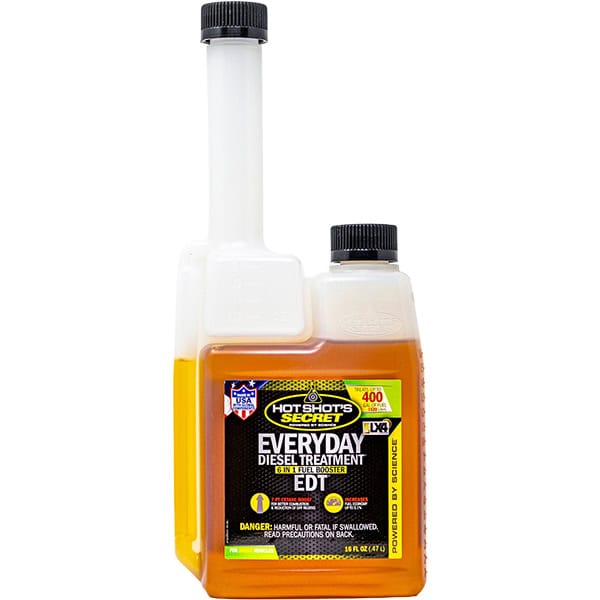
This is where a product like Hot Shot’s Secret Everyday Diesel Treatment (EDT) earns its place in the rotation. I have been running one ounce per tank since I got the truck, and half an ounce when I fill up at the halfway mark. It does not smell great. I do not care. It does not have to smell good.
EDT is a multifunctional additive that addresses several things at once. It improves lubricity, which matters for injector and pump longevity in a common-rail system. It raises cetane, which improves combustion efficiency and cold-start behavior. It contains detergents that keep injectors clean over time. And it has components that help modify wax crystal formation in cold weather, which gives you a modest improvement in cold-weather operability on top of whatever the seasonal blend is already doing.
The key word there is modest. An additive is not a substitute for winter blend fuel. If you are in a region that stays cold and you are buying summer blend because the station has not turned over its tanks yet, an additive will help but it will not fully compensate. The right answer is winter blend diesel plus a good additive, not summer blend diesel plus faith in a bottle.
Where an additive like EDT does consistent, measurable work is in the middle of winter when everything is already correct. Better lubricity, better cetane, cleaner injectors over time. These are marginal gains that compound across tens of thousands of miles. A new common-rail diesel with high-pressure injectors is not the place to skip that kind of maintenance.
Summer Blend and What to Expect Coming Out of Winter
As the weather warms up and the fuel at your local stations transitions to summer blend, you should notice your fuel economy tick back up slightly. The difference is usually in the range of one to three miles per gallon depending on your driving mix and how cold the winter was. If you have been tracking your mileage carefully, you will see it move in the right direction as spring settles in.
Summer blend also tends to have better energy density and, in many formulations, a higher cetane number than winter blend. For a truck that is working, towing, or running highway miles in warm weather, summer diesel is the better fuel. It is what the engine is optimized for. The cold-weather additives in winter blend are a necessary compromise, not a performance upgrade.
One thing worth knowing: in very hot climates, summer blend diesel can have a higher vapor pressure than you want in extreme heat, which can contribute to fuel system vapor issues. In northern Indiana, that is not a problem you will encounter. File it under things that matter somewhere else.
Does Any of This Show Up on the Truck?
For most new diesel owners, the answer is yes, you will see it. Fuel economy is the most obvious signal. The Sierra’s trip computer tracks this reasonably well, and if you pay attention across a full tank you will notice the seasonal pattern develop over your first year of ownership. Cold mornings in January with winter blend will cost you a few miles per gallon compared to a warm July highway run on summer blend.
You may also notice slightly easier cold starts as the transition to summer blend happens. The higher cetane in summer formulations means the fuel ignites more readily under compression, which shows up as a crisper, faster start. It is not dramatic on a modern engine with good glow plugs, but it is there.
What you should not notice is any warning lights, filter restriction indicators, or loss of power, as long as the fuel at your station is appropriate for the temperature and you are running a decent additive. If you do see the filter restriction warning on a cold morning, do not ignore it. That is the system working as designed, and it is telling you the filter is fighting harder than it should be.
Bottom Line
Summer vs winter diesel fuel is a real difference in product formulation with real consequences for cold-weather operability and warm-weather efficiency. Refiners blend for the season, but the transition is not always clean, and the autumn changeover is the one that bites people. The 3.0L Duramax has good cold-weather protection built in, but it is not a substitute for fuel that is actually blended for the conditions. Run a quality multifunctional additive year-round, pay attention to your fuel economy across seasons, and know that the small drop in winter mileage is the fuel, not the truck. Come spring, you will see it come back.